


By Anonymous
For Granite State Report
When I first walked into Belknap House in Laconia, I thought I’d found a safe haven. It looked homey enough—warm colors, playrooms for the kids, a kitchen where families could cook together. But it didn’t take long to realize that behind the smiles and the mission statements, Belknap House runs more like a low-security prison than a place of refuge.
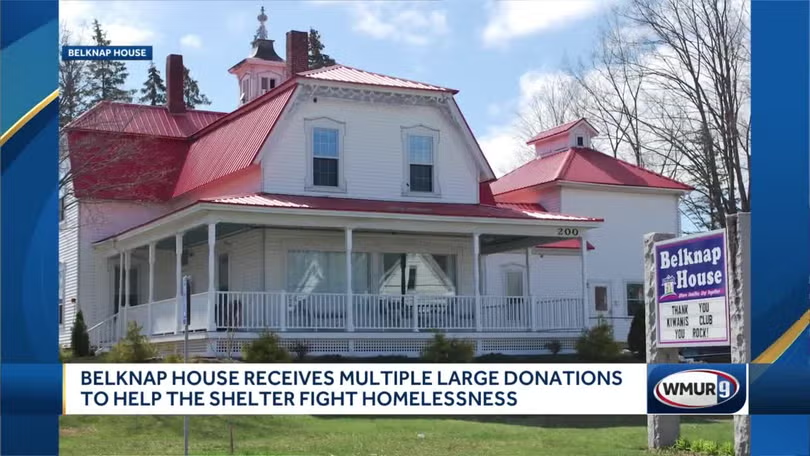
There are cameras in nearly every hallway and common area. You can’t move without being seen. You check in when you arrive, and check out when you leave—like signing a timesheet for your own confinement. Forget about privacy; it doesn’t exist. Even your medication is confiscated “for safety.” Staff lock it up and decide when you can take it. It doesn’t matter if it’s antidepressants, blood pressure pills, or something you’ve managed responsibly for years—the rule is control.
They also drug test you at random. Nobody tells you why or what happens if you fail. Guests aren’t allowed. Friends, family, anyone who might make you feel human again—they’re kept out. You start to understand the unspoken rule: once you’re in the system, you belong to it.
Then comes the curfew. You have to be inside by a set time every night or risk losing your spot. Bedtime is enforced like it’s a summer camp for adults who’ve broken invisible rules. And if that wasn’t infantilizing enough, there are mandatory “life skills” classes—parenting workshops, budgeting sessions, nutrition seminars. On paper, it sounds noble. In practice, it’s a box-ticking exercise that assumes you’ve never raised a child or managed a household before. The topics often have nothing to do with your situation. You’re not being asked what you need—you’re being told what’s good for you.
For me, that’s where the hope started to fade. It wasn’t that I didn’t want structure. It’s that I needed to be treated like a person, not a project. Most of us who end up in a shelter aren’t there because we’re lazy or lost. We’re there because life hit harder than we could afford—rent went up, a job disappeared, a partner became violent, or a system that’s supposed to help us simply didn’t. What Belknap House offers is safety, yes. But safety without dignity isn’t safety at all—it’s custody.
The staff mean well. Many of them are kind. But the policies they enforce turn that kindness into surveillance. They say they’re keeping you safe, but it feels more like they’re keeping you under control. Every rule—no guests, no freedom with medication, no late nights—sends the same message: you can’t be trusted.
By the time you’re ready to move out, you’ve learned how to comply, not how to live. You’ve learned that help in this state often comes wrapped in suspicion. That the price of a bed and a roof is your autonomy.
I don’t doubt that Belknap House saves lives. It probably saved mine, at least for a while. But it did so by breaking down what little independence I had left. The day I left, I didn’t feel free. I just felt released.
🔒 Ways Belknap House Might Feel Like a Prison
Constant Surveillance
– Cameras in common areas and outside feel invasive.
– Staff may monitor conversations or activities closely.
Lack of Privacy
– Families share close quarters.
– There may be frequent, unannounced room checks.
– No space to decompress or process emotions alone.
Excessive Control
– Strict curfews and daily schedules.
– Must ask permission for basic tasks (e.g. leaving, cooking).
– Required chores may feel more like forced labor than community care.
Medical and Personal Intrusions
– Questions about your health, medications, or parenting choices that seem unnecessary.
– Feeling like you’re being evaluated or watched more than helped.
Punitive Structure
– Rules enforced harshly or inconsistently.
– Fear of being kicked out for minor issues.
– “Three strikes” or “zero tolerance” policies without hearing your side.
No Real Voice or Power
– Residents aren’t involved in decisions.
– Staff may be condescending or dismissive.
– Complaints might be ignored or held against you.

